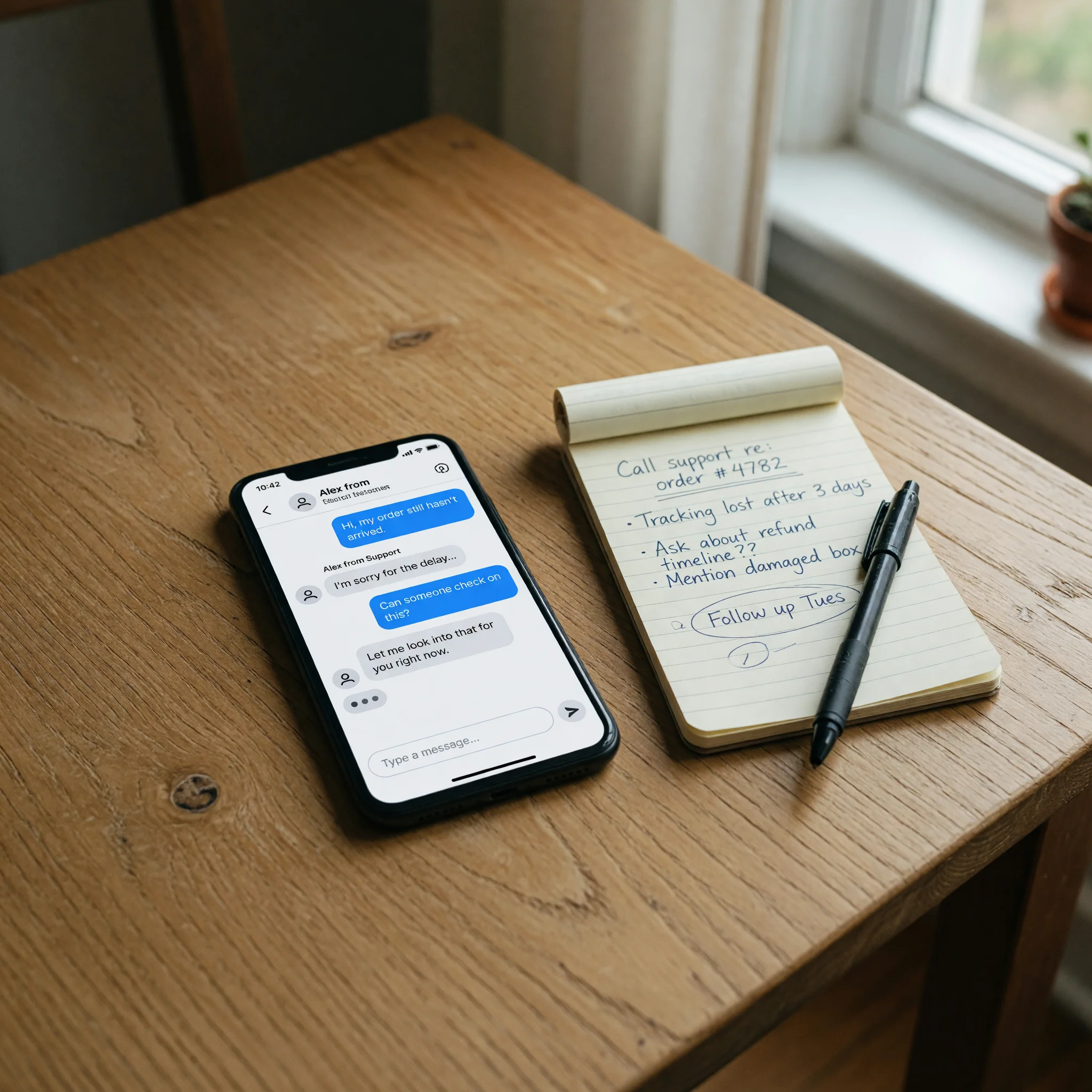
The four channels
Every licensed operator publishes four customer-care channels: live chat (in-app or on the website), email, phone, and a self-service help centre. The channels are ranked by response speed: live chat is fastest (typically under 15 minutes during business hours), email is moderate (24–48 hours), phone is fastest for urgent issues but limited to business hours, and the help centre is self-service.
The desk recommends live chat for time-sensitive issues (KYC rejection, payout stall, account access problem) and email for documentation-heavy requests (account closure, complaint submission, dispute escalation). Phone is best when live chat and email both stall.
What a good first response looks like
A good first response acknowledges the issue, names a case owner, and gives an estimated resolution time. A generic first response — a copy-paste block with no acknowledgement of the specific issue — is a desk flag in the review ledger.
Examples of good first responses:
- "Hi Ananya, I see your KYC was rejected on 28 July. I'm Priya from the KYC desk and I'm looking into it now. Expected resolution: 4 hours."
- "Hi Rohit, your withdrawal of ₹2,500 is stalled on our side. I'm Sanjay from the payments desk. I'll trace the transaction and update you within 2 hours."
The escalation path
When the first response is generic, the desk recommends escalating through three steps:
- Reply with the specific case ID and a one-paragraph summary of the unresolved issue.
- Ask for a named case owner and a resolution timeline in writing.
- If the second response is still generic, escalate to the operator's grievance officer (every operator publishes one in the help centre).
The grievance officer is the operator's last internal escalation. If the grievance officer does not resolve within 72 hours, the next step is the operator's regulator (MeitY for online skill games, or the relevant state authority for state-licensed operators).
Dispute resolution
Disputes — failed deposits, stalled withdrawals, KYC rejections, payout errors — follow the same escalation path. The desk recommends documenting every communication: case ID, agent name, timestamp, and the body of the message. Documentation is the deciding factor when a dispute reaches the regulator.
Independent helplines
If the issue is gambling-related — a session loss, a financial worry, a pattern of loss — the right first call is an independent helpline, not the operator. iCall (9152987821) and the Vandrevala Foundation (1860-2662-345) are the two most widely cited Indian helplines for gambling-related support.
Support questions, answered
What if no channel responds?
Document the lack of response with timestamps and screenshots. Escalate to the grievance officer; if the operator still does not respond within 7 days, file a complaint with MeitY.
Can I request a refund?
Yes — for documented disputes. The refund process is operator-specific, but most operators honour refunds for failed deposits and KYC-rejected accounts.
How do I report an unlicensed operator?
Report unlicensed operators to MeitY and the relevant state authority. The desk's corrections page accepts tips on unlicensed operators.
What if my account is locked?
A locked account is usually a KYC, security, or compliance issue. Contact customer care with your account details and the lock reason; most locks are resolved within 24 hours.
Is the customer-care channel monitored 24/7?
Most operators publish 24/7 chat coverage but business-hours phone coverage. Email is always 24/7 but typically responds within 24 hours.