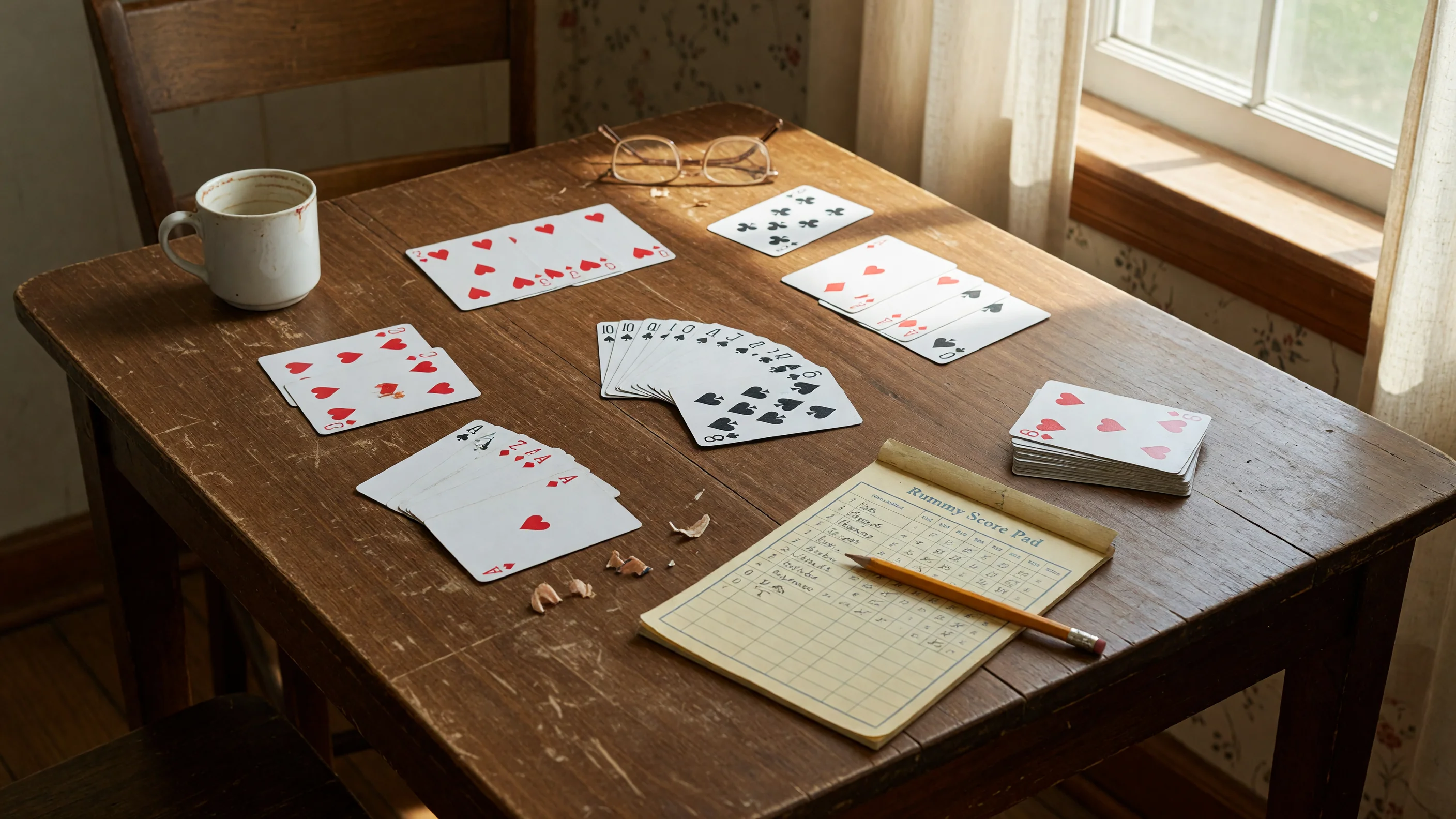
Meld
A valid grouping of three or more cards. The two kinds of meld are sequences (cards in consecutive order, same suit) and sets (cards of the same rank, different suits). A valid 13-card hand contains at least two melds at declaration.
Pure sequence
A run of three or more consecutive cards of the same suit, with no joker involved. 4-5-6 of spades is a pure sequence; A-K-Q of hearts is a pure sequence. A valid declaration requires at least one pure sequence — there is no exception to this rule.
Impure sequence
A run of consecutive cards of the same suit where one card is a printed joker or a wild joker standing in for the missing rank. 4-joker-6 of clubs is an impure sequence. The joker is committed when the sequence is declared.
Set
Three or four cards of the same rank in different suits. Three 7s — one heart, one diamond, one club — is a set. Four 9s is a set but only if the table allows four-card sets; most do, but check before you declare.
Drop
Folding the hand before declaring. A first drop (before your third turn) costs 25 points; a middle drop costs 50 points; a full count is the face value of unmatched cards up to the score limit.
Declare
Laying all 13 cards down in valid melds to end the hand. A declaration requires at least one pure sequence; an invalid declaration carries a maximum score penalty.
Showdown
The resolution of a declared hand. Deadwood is counted against the losers; the declarer scores zero (or wins the pot).
Deadwood
Unmatched cards left over after a hand. Deadwood counts against the holder at showdown.
Joker
Two jokers exist in a standard 13-card rummy deck: the printed joker (a designated card from the stock) and the wild joker (a card selected at random by the dealer). The wild joker substitutes for any missing card in an impure sequence or any missing rank in a set.
Stock
The face-down pile of undealt cards. Players pick from the top of the stock to add to their hand; the discarded cards sit face-up in the open pile.
Open pile
The face-up discard pile. Players can pick from the open pile to add to their hand; picking from the open pile signals intent to the table.
Buy-in
The entry stake for a Pool Rummy table. Every player at the table buys in for the same amount; the last player standing wins the pool minus an operator fee.
Score limit
The maximum deadwood count that counts against a player at showdown. Most rooms cap at 80, regardless of how bad the hand actually was.
Knock
The Gin Rummy declaration: laying your hand face-up and conceding the deadwood count. A "knock" with zero deadwood is a "gin".
Variant
A format variation. Points, Pool and Deals are the three standard variants; Gin Rummy is a two-player variant; Rummy 500 is a family-room variant.
Glossary questions, answered
Where do I find the printed joker rule for a specific room?
Every room publishes its joker rule in the lobby or in the table rules. The desk tracks the rule on a per-operator basis in the review ledger.
Is there a single authoritative rummy glossary?
No. The desk publishes this glossary as a reference. Other glossaries exist; the desk uses the terms above consistently across all its pages.
How do I submit a new term?
Use the corrections page. New terms are reviewed quarterly and added when they appear in operator-issued rulebooks.
Are the Hindi or regional-language equivalents published?
The desk publishes this glossary in English. The Devanagari script is loaded in the page stylesheet so a translator can extend the glossary; the desk has not yet produced the translated version.